import numpy as np
import pandas as pd

rng = np.random.default_rng(42)
n = 400

Z = rng.normal(size=n)
X = 0.6 * Z + rng.normal(scale=0.4, size=n)
M = 0.5 * X + rng.normal(scale=0.3, size=n)
Y = 0.7 * M + 0.2 * X + 0.4 * Z + rng.normal(scale=0.3, size=n)

df = pd.DataFrame({"Z": Z, "X": X, "M": M, "Y": Y})SCM vs Regression Adjustment
Does increasing treatment X raise outcome Y when confounder Z affects both, and mediator M carries part of the effect? This page runs that total-effect question through two estimators on the same DAG and dataset: a full structural causal model (SCM) with ate(), and a backdoor-adjusted outcome regression via adjustment_model().ate(). When the assumptions line up, the two ATEs should agree; when the structural model is wrong in places the adjustment model never had to model, they can diverge without either estimator being “broken.”
The causal question and DAG
We simulate a linear-Gaussian system with a fork confounder and a mediator on the path from X to Y.
The structural specification encodes every mechanism we believe is active.
import pathmc

spec = """
X ~ Z
M ~ X
Y ~ M + X + Z
"""

scm = pathmc.model(spec, data=df)
scm.graph()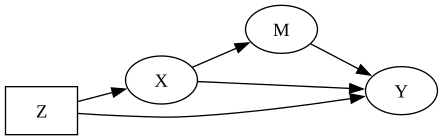
The research question is the total effect of X on Y: how much does Y change if we intervene to set X one unit higher, holding the causal graph fixed? That is an interventional quantity, not the slope from a naive regression of Y on X.
Estimator A: structural SCM and g-computation
Fit the full structural model: every equation in the spec is estimated jointly. ate("Y", "X") applies graph surgery and forward-simulates through the fitted mechanisms. Pearl calls this structural g-computation (truncated factorization): intervene on X, propagate through M and Y, and average the contrast.
scm.fit(random_seed=42)
scm_ate = scm.ate("Y", "X", values=(0.0, 1.0))
scm_ate
Initializing NUTS using jitter+adapt_diag...
Multiprocess sampling (4 chains in 4 jobs)
NUTS: [beta_Y, sigma_X, beta_X, sigma_M, beta_M, sigma_Y]Sampling 4 chains for 1_000 tune and 1_000 draw iterations (4_000 + 4_000 draws total) took 3 seconds.ATE of X on Y
| Mean | 0.55 |
| 94% HDI | [0.47, 0.63] |
| P(> 0) | 1.00 |
| Draws | 4000 |
The returned EstimandResult is the shared result type for causal contrasts: posterior mean, HDI, and sign probabilities use the same accessors whether the estimator is structural or regression-based.
scm_ate.mean()0.5525972549174982scm_ate.hdi(prob=0.94)array([0.47360139, 0.63091649])scm_ate.prob("> 0")1.0Estimator B: regression adjustment and standardization
adjustment_model() keeps the original DAG for context but fits a single reduced outcome equation identified by the backdoor criterion. It exposes the chosen set and formula before you sample.
adjusted = scm.adjustment_model("X -> Y")
adjusted.adjustment_setfrozenset({'Z'})adjusted.formula'Y ~ X + Z'This path is outcome-regression standardization: fit Y ~ X + Z, predict counterfactual outcomes at each observed covariate profile, and average the contrast. It is g-computation on one equation rather than on the full factorization.
adjusted.fit(random_seed=42)
adj_ate = adjusted.ate(values=(0.0, 1.0))
adj_ate
Initializing NUTS using jitter+adapt_diag...
Multiprocess sampling (4 chains in 4 jobs)
NUTS: [beta_Y, sigma_Y]Sampling 4 chains for 1_000 tune and 1_000 draw iterations (4_000 + 4_000 draws total) took 2 seconds.ATE of X on Y
| Mean | 0.56 |
| 94% HDI | [0.48, 0.65] |
| P(> 0) | 1.00 |
| Draws | 4000 |
The stamped metadata records estimator="regression_adjustment", but the accessors match the SCM run.
adj_ate.mean()0.5633434977579431adj_ate.hdi(prob=0.94)array([0.48038605, 0.65158295])adj_ate.prob("> 0")1.0Compare the ATEs
Side by side, both estimators target the same total-effect estimand when the linear-Gaussian structural model is correctly specified and the adjustment set blocks every backdoor path.
import pandas as pd

comparison = pd.DataFrame({
    "Estimator": [
        "Structural SCM (g-computation)",
        "Regression adjustment (standardization)",
    ],
    "ATE mean": [scm_ate.mean(), adj_ate.mean()],
    "94% HDI low": [
        scm_ate.hdi(prob=0.94)[0],
        adj_ate.hdi(prob=0.94)[0],
    ],
    "94% HDI high": [
        scm_ate.hdi(prob=0.94)[1],
        adj_ate.hdi(prob=0.94)[1],
    ],
    "P(ATE > 0)": [scm_ate.prob("> 0"), adj_ate.prob("> 0")],
})
comparison| Estimator | ATE mean | 94% HDI low | 94% HDI high | P(ATE > 0) | |
|---|---|---|---|---|---|
| 0 | Structural SCM (g-computation) | 0.552597 | 0.473601 | 0.630916 | 1.0 |
| 1 | Regression adjustment (standardization) | 0.563343 | 0.480386 | 0.651583 | 1.0 |
With the simulated coefficients, the true total effect is about 0.5 \times 0.7 + 0.2 = 0.55. The two posterior means should land near that value and near each other, within MCMC noise.
When the estimators diverge
Disagreement is not always a software bug. The SCM estimator propagates every equation you wrote; the adjustment estimator only needs the outcome equation and the adjustment set to be right for the total effect.
Suppose we misspecify the Y equation by dropping the paths through M and X, keeping only Y ~ Z while still listing M ~ X in the spec.
misspec = pathmc.model(
    """
    X ~ Z
    M ~ X
    Y ~ Z
    """,
    data=df,
)
misspec.fit(random_seed=42)
misspec_ate = misspec.ate("Y", "X", values=(0.0, 1.0))
misspec_ate.mean()
Initializing NUTS using jitter+adapt_diag...
Multiprocess sampling (4 chains in 4 jobs)
NUTS: [sigma_X, beta_X, beta_M, beta_Y, sigma_M, sigma_Y]Sampling 4 chains for 1_000 tune and 1_000 draw iterations (4_000 + 4_000 draws total) took 2 seconds.0.0Structural g-computation has no route from do(X) to Y in that wrong Y equation, so the SCM ATE collapses toward zero even though the data still carry a real effect of X on Y. The adjustment model built from the correct DAG still fits Y ~ X + Z and recovers a nonzero ATE.
pd.DataFrame({
    "Estimator": [
        "Correct SCM",
        "Misspecified SCM",
        "Regression adjustment (correct DAG)",
    ],
    "ATE mean": [
        scm_ate.mean(),
        misspec_ate.mean(),
        adj_ate.mean(),
    ],
})| Estimator | ATE mean | |
|---|---|---|
| 0 | Correct SCM | 0.552597 |
| 1 | Misspecified SCM | 0.000000 |
| 2 | Regression adjustment (correct DAG) | 0.563343 |
The lesson: a focused outcome regression can be more robust to misspecification outside the outcome equation, while a full SCM rewards correct mechanism writing everywhere.
What only the SCM can answer
Total-effect ATE parity does not mean the two objects are interchangeable. The fitted SCM still supports path-specific queries and interventions on mediators.
scm.effect("X -> M -> Y")EffectResult — X -> M -> Y
| Mean | 0.3187 |
| SD | 0.0289 |
| 94% HDI | [0.2660, 0.3724] |
| P(> 0) | 1.0000 |
| Draws | 4000 |
scm.do(set={"M": 1.0})DoResult — 4000 draws, 4 variables
| variable | mean | 94% HDI |
|---|---|---|
| Z | -0.01 | [-0.01, -0.01] |
| X | -0.02 | [-0.06, 0.02] |
| M | 1.00 | [1.00, 1.00] |
| Y | 0.67 | [0.56, 0.77] |
AdjustmentModel is scoped to its designated X -> Y query. It has no effect() method and no way to intervene on M while retaining the full DAG semantics; path-specific and mediator interventions require the structural PathModel.
NoteSame ate(), different scope
Both estimators expose ate() with the same EstimandResult accessors. The SCM answers any query the graph supports; the adjustment facade answers one treatment-outcome pair with a reduced likelihood.
Next steps
The tradeoff table in Estimation Approaches summarizes assumptions versus scope at the conceptual level. This page showed the computation on one problem.
For estimand definitions and the do-operator API, see Causal Inference. For the shared predictions() / comparisons() / slopes() API on both estimators, see Predictions, Comparisons, and Slopes. For flexible GLM formulas and GAMs that pathmc does not own, Bambi remains a strong regression-adjustment backend once identification is settled.