import numpy as np
import pandas as pd
import matplotlib.pyplot as plt
import pathmc

rng = np.random.default_rng(sum(map(ord, "dag falsification")))
n = 1500Falsifying a Whole DAG
Grade an entire DAG against a permuted-baseline test: does it break its conditional-independence promises, and is it even informative enough to be falsified?
This page assumes you have read Testing your DAG against data (“Testing Your DAG Against Data”), which teaches the conditional independences a DAG implies and how test_implications() checks them one missing edge at a time. That is the prerequisite for everything below: falsify() reuses the same conditional-independence machinery but asks a bigger question about the graph as a whole — is this causal story compatible with the data at all, and is it even specific enough to be tested?
It ports dowhy’s gcm.falsify_graph (Eulig et al. 2023) and answers two distinct questions:
- Does the graph break its promises? The Local Markov Condition (LMC) is the requirement that every variable be independent of its non-descendants given its parents. This step counts how many of the DAG’s implied LMC independences the data actually violate.
- Is the graph informative at all? Permute (rewire) the node labels to build random competitor DAGs and check whether the proposed DAG fits the data meaningfully better than the random pile. This node-permutation comparison is the test of permutation adjacency (tPA): if the data cannot distinguish your arrow directions from a shuffle, the test cannot falsify your DAG no matter how good it is.
An informative DAG that beats the LMC baseline is the positive case — not contradicted and testable. The verdict has two distinct failure modes, so read it carefully: a DAG can be not rejected either because it genuinely passes (informative and beats the baseline) or because it is not falsifiable in the first place (too few permutations distinguish it — falsifiable == False). The second case is not evidence for the graph; the conclusion is simply vacuous.
Setup
A data-generating process to test against
We simulate a five-variable system so the permutation test has enough structure to be informative. The true DAG is a diamond feeding a chain: A → B, A → C, B → D, C → D, D → E.
A = rng.normal(size=n)
B = 0.8 * A + rng.normal(scale=0.5, size=n)
C = 0.7 * A + rng.normal(scale=0.5, size=n)
D = 0.6 * B + 0.5 * C + rng.normal(scale=0.5, size=n)
E = 0.9 * D + rng.normal(scale=0.5, size=n)

df = pd.DataFrame({"A": A, "B": B, "C": C, "D": D, "E": E})
The true DAG is not rejected
When the proposed DAG matches the data-generating process, it violates none of its implied conditional independences and clearly beats the permuted baseline.
true_model = pathmc.model(
    """
    B ~ A
    C ~ A
    D ~ B + C
    E ~ D
    """,
    data=df,
)
result = true_model.falsify(n_permutations=200, random_seed=1)
result
DAG Falsification (α = 0.05)
✓ Not rejected — the DAG is informative and beats the permuted baseline.
| Informative (falsifiable) | Yes |
| Permutations in Markov equivalence class | 2 / 120 (p = 0.017) |
| LMC violations (given DAG) | 0 / 6 |
| Beats permuted baseline | 98.3% (p = 0.017) |
Because this graph has only five nodes (≤ 7), requesting n_permutations=200 enumerates all 5! = 120 distinct relabelings exactly rather than sampling — so the baseline is deterministic and random_seed has no effect here. result.n_permutations reports the actual count (120).
The verdict has two parts. Informative means few of those 120 relabelings share the DAG’s Markov equivalence class — so the arrow directions are characteristic enough to be testable. Beats the baseline means the DAG violates fewer Local Markov Conditions than almost all of the competitors. Both hold, so the DAG is not rejected.
The histogram makes the comparison visual: the dashed line (the given DAG) sits at the far left of the permuted baseline (it violates far fewer conditions than a random rewiring).
result.plot()
plt.show()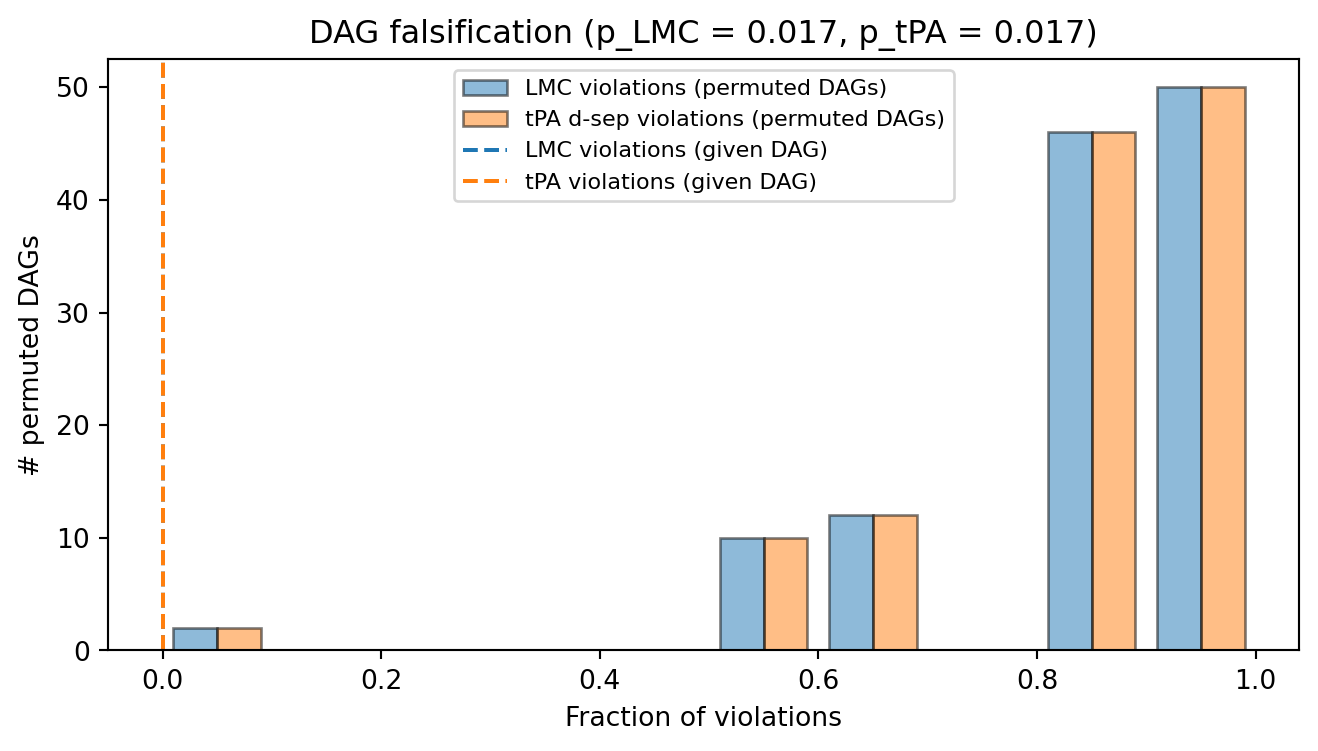
A wrong DAG is rejected
Now suppose an analyst removes a true edge (C → D) and adds a wrong one (E → C). The graph is still informative, but it now violates conditional independences the data refuse to honor.
wrong_model = pathmc.model(
    """
    B ~ A
    C ~ A + E
    D ~ B
    E ~ D
    """,
    data=df,
)
wrong_result = wrong_model.falsify(n_permutations=200, random_seed=1)
wrong_result
DAG Falsification (α = 0.05)
✗ Rejected — the data falsify this DAG.
| Informative (falsifiable) | Yes |
| Permutations in Markov equivalence class | 2 / 120 (p = 0.017) |
| LMC violations (given DAG) | 3 / 5 |
| Beats permuted baseline | 78.3% (p = 0.217) |
The DAG is still informative, but its LMC violations no longer beat the permuted baseline, so it is rejected. The local violations pinpoint where the story breaks:
wrong_result.violations| node | non_descendant | conditioning_set | p_value | violation | |
|---|---|---|---|---|---|
| 0 | C | B | A, E | 6.049329e-05 | True |
| 1 | C | D | A, E | 7.905171e-23 | True |
| 4 | D | A | B | 1.576939e-26 | True |
Each row is an implied independence node ⊥ non_descendant | conditioning_set that the data reject. These are the edges to revisit.
Falsification vs. edge-by-edge testing
falsify() and test_implications() are complementary:
| Question | Method |
|---|---|
| Which specific missing edge is contradicted? | test_implications() — one partial-correlation test per missing edge |
| Is the DAG as a whole better than random, and falsifiable at all? | falsify() — permutation baseline over the entire graph |
test_implications() is sharper for locating a single missing edge; falsify() adds the crucial “is this even a testable, informative DAG?” check and grades the whole graph on a curve. Use test_implications() to debug a flagged edge after falsify() rejects a DAG.
When a DAG cannot be falsified
Two situations make a DAG impossible to reject — and falsify() reports both honestly rather than giving false confidence.
Fully connected graphs make no predictions. A DAG with no missing edges implies no conditional independences, so there is nothing to test.
saturated = pathmc.model(
    """
    M ~ X
    Y ~ M + X
    """,
    data=df.rename(columns={"A": "X", "B": "M", "C": "Y"})[["X", "M", "Y"]],
)
saturated.falsify(random_seed=0)
DAG Falsification
Cannot be evaluated — the DAG implies no testable parental conditional independences.
Small graphs are often not informative. A three-node chain X → M → Y is Markov-equivalent to its reverse Y → M → X: both predict X ⊥ Y | M. A large fraction of permutations therefore share its Markov equivalence class, so the test reports the DAG as not informative — the data simply cannot distinguish these arrow directions.
chain_df = df.rename(columns={"A": "X", "B": "M", "C": "Y"})[["X", "M", "Y"]]
chain = pathmc.model(
    """
    M ~ X
    Y ~ M
    """,
    data=chain_df,
)
chain.falsify(random_seed=0).falsifiableFalseThis is a feature, not a limitation: it tells you the conclusion “not rejected” would have been vacuous, so you should rely on domain knowledge (or a larger graph) instead.
How the verdict is computed
The decision rule follows Eulig et al. (2023) exactly, using two permutation p-values:
p_value_tpa— the fraction of permutations lying in the DAG’s Markov equivalence class. The DAG is falsifiable (informative) whenp_value_tpa ≤ significance_level.p_value_lmc— the fraction of permutations whose LMC-violation rate is no worse than the given DAG’s. The DAG is falsified (rejected) only when it is strictly informative (p_value_tpa < significance_level) andp_value_lmc > significance_level(it fails to beat the baseline). The strict<matches Eulig et al. (2023): a DAG sitting exactly at the informativeness boundary is given the benefit of the doubt.
p_value_tpa (informativeness): 0.017
p_value_lmc (beats baseline):  0.017
falsifiable: True, falsified: False
WarningWhat this test can and cannot do
Conditional independence is tested with partial correlation — the same linear-Gaussian test as test_implications(). Purely nonlinear dependencies are not detected, so a “not rejected” verdict is only as strong as the linear-Gaussian assumption.
The permutation baseline needs structure. Tiny or sparsely connected graphs are frequently not informative; the test will say so rather than pretend to validate them.
Consistency is necessary, not sufficient. “Not rejected” means the data do not contradict the DAG, not that the DAG is true. Markov-equivalent DAGs are indistinguishable by any observational test.
Summary
- falsify() grades the whole DAG against a baseline of randomly rewired competitor graphs, rather than checking one edge at a time.
- It answers two questions: is the DAG informative (few permutations in its Markov equivalence class) and does it beat the baseline on Local Markov Condition violations.
- A DAG is rejected only when it is informative and fails to beat the baseline; the
.violationstable shows which implications break. - Not all DAGs are falsifiable — fully connected or small graphs make too few (or non-characteristic) predictions, and falsify() reports this rather than giving false confidence.
- Pair it with
test_implications()to drill into individual contradicted edges.
References
Eulig, Elias, Atalanti A. Mastakouri, Patrick Blöbaum, Michaela Hardt, and Dominik Janzing. 2023. Toward Falsifying Causal Graphs Using a Permutation-Based Test. https://doi.org/10.48550/arXiv.2305.09565.